
COVID-19 Simulation
I simulate the spread of an infectious disease with a simple model where a person can be sick, susceptible, recovered, or vaccinated. I see how factors such as interaction constraints, transmission probability, and vaccinations affect the spread of the disease in different population sizes and look for trends.
Covid 19 Simulation
In this project, I simulate the spread of an infectious disease with a simple model where a person can be:
Sick
Susceptible
Recovered
Vaccinated
Assumption: People who have recovered cannot get the disease again.
I will then see how factors such as transmission probability, vaccinations, and interactions affect the spread of the disease in different population sizes and look for trends.
All code was written in C++ (object-oriented programming).
Model 1: No interaction outside neighbors and no vaccine
In this model, I simulated how the disease would spread if there was only interaction between neighbors and there was no vaccine.

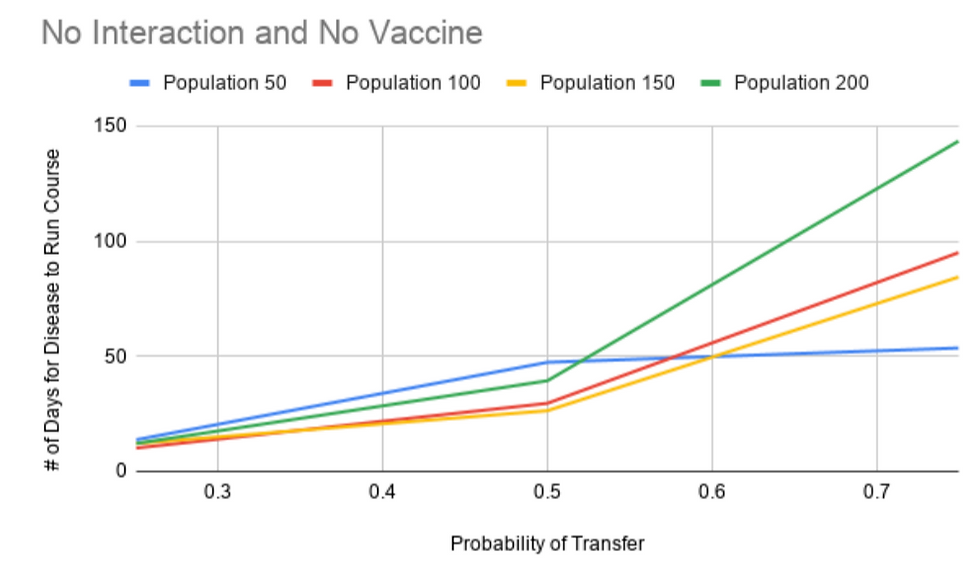
The general trend is that the higher the transmission probability, the longer the disease took to eradicate. This is most likely because as the transmission probability increased, more people got infected and spread it to others over time, elongating the recovery period.
Model 2: No interaction outside neighbors with Vaccine
In this model, I simulated how the disease would spread if there was only interaction between neighbors and there was a vaccine available to a percentage of the population chosen at random.


The trend with the vaccinations stays relatively constant because the spread is constrained to be solely between 2 vaccinated individuals that patient 0 falls between, therefore the transmission probability has a minimal effect on the number of days it takes for the disease to eradicate.
Model 3: Interaction outside Neighbors and No Vaccine
In this model, I simulated how the disease would spread if there was interaction between individuals outside of neighbors and there was no vaccine available. In this simulation, I assumed every person met 5 random people a day.


There is a general downward trend of how long the disease takes to eradicate as the transmission probability increases. This is the opposite of the first model, whereas the transmission probability increased, the disease took longer to eradicate. This is most likely due to the idea of herd immunity where everyone eventually gets infected and recovers. The tradeoff of the disease taking less time to eradicate in this scenario is that everyone gets infected. In the current situation we are in with the COVID-19 pandemic, the symptoms are too dangerous for herd immunity to be the solution because there is a death rate with this disease.
Model 4: Interaction outside Neighbors and a Vaccine
In this model, I simulated how the disease would spread if there was only interaction between neighbors and there was a vaccine.

Each of the population sizes showed the same trend as the previous model. Everyone got infected in these simulations besides the vaccinated individuals, and the higher the transmission probability, the less time it took for the disease to eradicate.
Conclusion
In conclusion, I think the last model with social interactions and a vaccine was the most accurate of the models because only interacting with your neighbors next to you is very unrealistic. This model demonstrated how the idea of herd immunity allows people to interact with one another and with a higher transmission probability, the disease will actually run its course faster. This makes sense, however, it implies that everyone gets infected which is not feasible with a virus such as COVID-19 which individuals can die from.